
About Us
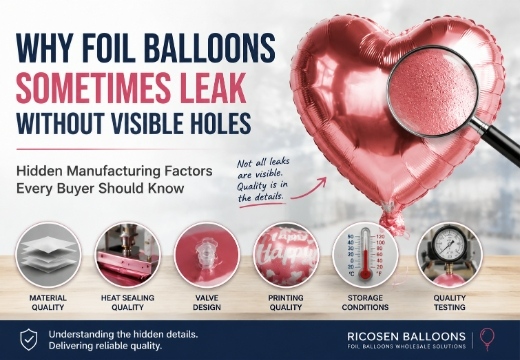
Why Foil Balloons Sometimes Leak Without Visible Holes: Hidden Manufacturing Factors Every Buyer Should Know
Views : 3
Update time : 2026-07-17 15:29:38
After years working with foil balloon production, we found that many quality complaints are not caused by visible damage, but by small differences in materials and manufacturing control.
Every balloon buyer has faced this frustrating situation:
A customer opens a new foil balloon, inflates it for a party, and finds it losing air much faster than expected — even though there is no visible hole.
For wholesalers and retailers, this is more than a product issue. It can lead to customer complaints, refunds, and damage to brand reputation.
Many buyers assume the problem comes from transportation or customer handling. However, the real reason often starts much earlier — inside the manufacturing process.
1. Not Every Balloon Leak Is Caused by Customer Handling
One of the biggest misconceptions in the balloon industry is that all leaks are caused by accidental punctures or overinflation.
These issues are often referred to as micro leakage, where tiny defects allow gas to escape slowly over time.
These tiny defects may not become noticeable immediately. Instead, the balloon gradually loses helium or air over several days, creating customer complaints that are difficult to explain.
This is why experienced manufacturers focus on preventing leaks before the balloon ever leaves the factory.
2.The Base Film Determines Long-Term Performance
The foundation of every foil balloon is its laminated film.Although many balloons appear identical externally, different factories often use different material structures.
Higher-quality laminated films provide:
- Better gas retention
- Greater flexibility
- Higher puncture resistance
- More stable performance during transportation
Many buyers believe all foil balloons use similar materials because the finished products look almost identical. However, the internal material structure can be completely different.
A Real Example: Why 40-Inch Number Balloons Need Stronger Materials
A common mistake among buyers is comparing foil balloons only by appearance and price.A 40-inch number balloon requires the material to withstand much greater stretching force compared with smaller balloons.
During inflation, the film around the edges and corners experiences continuous tension. If the material does not have enough strength and flexibility, stress can gradually affect the sealing area and increase the risk of slow leakage.
For this reason, many professional manufacturers choose nylon-based laminated materials for large number balloons.
Nylon provides better tensile strength and flexibility, allowing the balloon to expand more evenly while reducing stress on the sealed edges.
This difference becomes especially important for oversized foil balloons, such as 40-inch number balloons and large supershape balloons.
However, for cost reasons, some suppliers may use standard PET-based structures for oversized balloons where stronger reinforcement may be required.
Although the balloon may look similar after inflation, the performance difference can appear over time.
- Lower-strength materials may experience:
- Faster gas loss
- Higher stress around seams
- Reduced inflation time
- More customer complaints after purchase
3. Heat Sealing Quality Is More Important Than Most Buyers Realize
A foil balloon is essentially several pieces of laminated film permanently joined together.
If the sealing process is inconsistent, tiny gaps may remain along the edges.
Several production factors influence sealing quality:
- Sealing temperature
- Pressure consistency
- Sealing time
- Mold precision
- Seal width
In mass production, maintaining consistent sealing parameters across thousands of pieces is one of the biggest challenges for manufacturers.
During production, sealing machines must maintain precise temperature and pressure settings. Even small variations can create weak points that may not immediately fail during inspection but become leakage risks after inflation.
In many cases, balloons pass initial inflation tests but begin leaking after several days because the seal gradually separates under internal pressure.
This is one of the most common hidden causes of slow air loss.
4. Valve Design Plays a Bigger Role Than Most Buyers Expect
The self-sealing valve is one of the smallest components in a foil balloon, yet it has a major impact on product quality.
A poorly manufactured valve may:
- Allow slow backflow of helium
- Fail to seal completely after inflation
- Become loose after repeated handling
Because valve problems are often invisible, buyers may incorrectly assume the balloon material itself is defective.
This problem is especially noticeable when balloons are inflated with helium, as helium molecules are smaller and can escape more easily through weak sealing points.
5. Printing Quality Can Also Affect Balloon Durability
Many buyers focus on artwork and color accuracy, but printing also influences product performance.
Heavy ink coverage, improper curing, or unsuitable printing processes can reduce the flexibility of the laminated film.
As the balloon expands during inflation, excessive stiffness may create additional stress around the printed areas or sealed edges.
Professional manufacturers carefully balance print quality with material flexibility to ensure both attractive appearance and reliable durability.
For printed foil balloons, manufacturers also need to consider the relationship between ink coverage and film flexibility. Large printing areas require careful process control to avoid affecting balloon expansion performance.
6. Storage Conditions Matter Before the Balloons Even Ship
Even perfectly manufactured balloons can be affected by poor storage conditions.
Long exposure to excessive heat, humidity, or heavy stacking pressure may accelerate material aging before products reach customers.
Shipping containers crossing oceans often experience extremely high temperatures.
Well-manufactured balloons usually tolerate these conditions, while products made with lower-quality materials may develop sealing problems after transportation.
This is why storage management is considered an important part of quality control rather than simply warehouse management.
7. Professional Manufacturers Test More Than Just Appearance
Experienced suppliers understand that visual inspection alone is not enough.
Quality control should include multiple stages of testing, such as:
- Inflation retention testing
- Valve performance testing
- Seal strength inspection
- Random leakage testing
- Material consistency checks
- Batch sampling before shipment
Professional quality control is not only about checking whether a balloon can be inflated, but whether it can maintain performance after inflation.
These procedures help identify hidden defects before products reach the market.
What Buyers Should Ask Before Choosing a Foil Balloon Supplier
Choosing a supplier based solely on price can lead to expensive problems later.
Before placing an order, consider asking these questions:
- What material structure do you use for your foil balloons?
- Do you perform inflation retention testing?
- How long are balloons tested before shipment?
- What quality checks are performed on the sealing process?
- How do you inspect valve performance?
- What percentage of each production batch is sampled?
A Factory Reality: Why Some Leakage Problems Are Difficult to Detect
Not every quality issue appears immediately after production.
Some balloons can pass initial inspection but develop slow leakage after several days because internal pressure continuously pushes against weak areas.
This is why professional manufacturers do not rely only on appearance checks. Long-term inflation testing and batch inspections are essential.
Conclusion
When foil balloons slowly lose air without any visible holes, the problem is often far more complex than customer handling or transportation damage.Material selection, sealing technology, valve quality, printing processes, storage conditions, and quality control all contribute to the final performance of the product.
For wholesalers and brand owners, understanding these hidden manufacturing factors makes it easier to evaluate suppliers, reduce customer complaints, and build a reputation for reliable quality.
At Ricosen Balloons, we believe product quality is created through every small manufacturing decision — from selecting the right material structure to controlling sealing performance and testing finished products.
For balloon wholesalers and brand owners,choosing the right supplier is not only about getting competitive pricing. It is about building products that customers can trust.
Frequently Asked Questions
1.Why does my foil balloon lose air without a hole?
A foil balloon may lose air due to invisible issues such as weak sealing, valve problems, or unsuitable material structure.2.How long should a high-quality foil balloon stay inflated?
Inflation time depends on balloon size, material quality, valve performance, and environmental conditions.3.What material is better for large foil balloons?
For oversized balloons, stronger laminated structures with better flexibility and tensile strength generally provide more reliable performance.
4.Why do some foil balloons lose air faster after transportation?
Temperature changes, pressure variations, and long-distance shipping conditions can expose weak points in materials or seals. High-quality balloons are designed to handle normal transportation conditions, but poor manufacturing consistency may lead to leakage issues after arrival.
相关新闻
 Why Foil Balloons Sometimes Leak Without Visible Holes: Hidden Manufacturing Factors Every Buyer Should Know
Jul 17,2026
Why do foil balloons leak without visible holes? This article explains the hidden manufacturing factors affecting foil balloon durability, including materials, sealing, valves, printing, storage, and quality testing. Learn how professional buyers evaluate suppliers and avoid quality problems.
 How Successful Balloon Retailers Build a Product Mix That Sells All Year
Jul 10,2026
A successful balloon business isn't built by offering the most products—it's built by offering the right mix of products.
This guide introduces the 70-20-10 Product Mix Framework, a practical approach that helps balloon retailers balance evergreen products, seasonal collections, and trend-driven items for healthier inventory, stronger cash flow, and more consistent year-round sales. Whether you're expanding your product assortment or refining your purchasing strategy, this framework offers actionable insights to build a more profitable retail business.
 How Retail Buyers Reduce Inventory Risk When Choosing Balloon Suppliers
Jul 01,2026
Reducing inventory risk begins long before products arrive at the warehouse. This article explores how experienced retail buyers evaluate balloon suppliers beyond price, focusing on predictable lead times, flexible product assortments, market insight, and long-term supplier partnerships. Learn the practical purchasing strategies that help retailers improve inventory turnover, protect cash flow, and make more confident sourcing decisions.
 Why Some Balloon Products Become Best Sellers While Others Sit on Shelves
Jun 24,2026
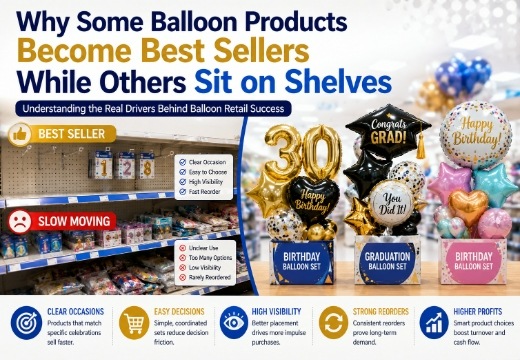
Not all balloon products perform equally in retail environments. While some become consistent best sellers, others struggle to gain customer attention despite attractive designs and competitive pricing. This article explores the key factors that influence retail balloon sales, including occasion-based demand, product simplicity, coordinated product sets, color trends, merchandising visibility, and reorder behavior. Retailers can use these insights to improve inventory turnover, increase average order value, and make smarter purchasing decisions.